No one knows what the body can do. -Spinoza

Showing posts with label Reflection. Show all posts

Thursday, June 30, 2011

Iconic Photo: Photo 30 (2 days late)

The Truth Is Always This--I look good in black leather, and black leather-like, or black plastic, black rubber, or other black leather-like variants, but I really love a marshmallow: A Book To Be Written by Lily-Elaine and Matt

Or, The 30-Day Iconic Photo Challenge, A Consideration of Relationships, and An Account of Why Daphne Guinness is Important, plus snacks, plus wine


(Also known as: there's too damned much in this here post but we're going to do it anyway)

Daphne Guinness
Vogue Italia 2010

Here's the thing. In an attempt to refocus on my blog I posed a 30-day challenge for myself--to post a different iconic photo of an inspirational woman everyday for 30 days. The idea, for me, was that the image would somehow be iconic and it would point us to a woman whose story inspired us to see how we could choose what lives we want for ourselves, doing so could mean surpassing both our own and others expectations for us, and in so doing we could possibly create something uniquely our own, and so then also new.

There are, of course, innumerable women in the world that could be taken as inspiring, and innumerable others that are, of course, iconic--they stand in the midst of the mundane everyday as someone that we would wish to be, or that we recognize as importantly human, or that shine as a reminder of how brilliantly simple human elements can come into concert and so become a symphony.

The trouble, for me at least, is that approaching the end of the 30-day iconic photo challenge I'd set for myself I suddenly froze. There I was with only one day left and I suddenly couldn't come up with any clear sense of what photo, or what woman I'd want to feature on the 30th day. In that final day I unexpectedly faced a kind of meaning to the 30th day, the final day, I hadn't anticipated--the woman featured on the 30th day would provide a kind of frame to the rest of the women featured in the challenge. Her image and brief biography would offer a way of interpreting all the women that had been chosen before her. In the pressure of such high demand I didn't know who to choose and so on the 30th day I ended up posting no one. I failed my own challenge.

Honestly, right this minute, having now picked someone to post for the 30th day, I could just back-date this very message and act as though nothing had been missed at all. I'd just casually insert the final image on the day that would have been day 30 and go on as though I'd missed nothing. But, instead, maybe because I'm a pain in the ass, maybe because I want to offer an explanation, maybe because I need to come to terms with just my self, or maybe because I ate too many beans and didn't drink enough coffee--FOR SOME REASON instead here I am typing away in a semi-non-sequiter rambling that will all eventually come around to the woman I've chosen for the last day, Daphne Guinness.

Daphne Guinness
buy life campaign

Continuing in this moment of seeming non-sequiter I have to make a confession. Without any advanced warning that this would happen, my 30 days of iconic photos of inspirational women happened to overlap with a profound personal event. It turns out near the beginning of the month I met someone I liked an awful lot and over the course of the month I actually fell in love. There's a saying that comes from somewhere all insightful and wise that says Love is a spontaneous grass, not a garden plant. That is, it comes up in fresh ground, almost unexpected, without being intentionally cultivated, and truth be told, without your input or control. The thing is, I've resisted those kinds of views about love. I have long thought of it as a more determined thing, and even if I was willing to grant that perhaps the feelings could not be directly controlled part of me tried to maintain that I could somehow sculpt the channel through which they'd flow, there by shaping how the feelings would go. There's a sense in which this has "worked" for me, in as much as controlling our feelings can ever work for anyone--it's a little like pouring freshly shaken soda pop down a fountain--even if the liquid more or less follows the predetermined path it's gonna bubble and blow all over other stuff too.

Somehow before this last month my own attempts to control such things had waned. I can't exactly say how I managed this except that I know I have spent the last year very intentionally simplifying my own life and I believe that through this process I opened my self up to greater intimacy with my own feelings--living in a kind of communion with them, rather than needing to try and direct them as objects separate from me.

Let me say I tried, when I met this person I liked a lot, not to fall in love. First I called and told him we couldn't see each other. He responded so well to that though I realized I wanted to see him and relented. So we visited together and I liked it a lot and then I freaked out again and said again we couldn't see each other. Then I was walking through town and somehow ended up in the same general area that he was so I tried to cross the street before bumping into him and without realizing it put myself right on the edge of a SIDEWALK CLOSED CROSS BACK TO OTHER SIDE OF THE STREET situation. Really. The avoidance route wasn't open to me anymore. So I crossed back over to the original side of the street, and then a few minutes later there he was beside me calm and smiling. After that we started spending more regular time together. (Honestly, I actually freaked out again more and everytime there he'd be beside me calm and smiling. The truth is I've never had anyone capable of doing that with me. In the past I've had to be the one that stays calm and smiling while someone else freaks out, and if it was my turn to freak out there wasn't really someone there to stay calm next to me. I'd end up in a room on my own talking myself through it.)

Anyway, the point of all this is it's been a struggle for me. In the midst of falling in love I've faught myself outside my own heart quite a lot, while inside my own heart I've softened and come to understand myself in an entirely new way. It isn't that I've gone without feelings for others in the past. It's that this time I've gotten to be more fully myself in the midst of them, and be more fully recognized by him than anyone has before. Still, it's been hard.

What the hell does any of this have to do with Daphne Guinness?

Here's part of the tension I'm dealing with--my heart is open and in a sense has already given itself to someone. In that level of simple connection I feel as though we are two hands calm and holding each other. In that I feel a kind of constancy I want, a constancy that inspires me to think better of myself, to see life as more fully full of possibility, to recognize that I can passionately choose the life I want. At the same time, the future of this situation is fully indeterminate. It is of course indeterminate in that existentialist sense of life is wide open and we can't predict where it will take us. But, the future of this particular circumstance is also indeterminate in the literal sense--we've only recently met and started spending time together and our everyday life plans right now appear to take us in significantly different directions. (I choose here not to get into details out of respect for both our privacy, but let me just say it's all more about geography than any more green and gobbly relationship eating monsters in case you're out there projecting all kinds of panic and worry into all this for my sake.)

It would be easy in such a situation to decide in advance that things can't work and to close down to all the feeling I've had. Or, it could be easy (for a time) to naively give myself away to just the feeling and dwell in the fantasy of what I imagine is possible hoping everyday life will eventually match up. The bigger challenge, and the one I'm recognizing is essential for me to live out here, is the risky maneuever of honestly facing both truths of this relationship--my heart is open and has given itself to someone, and what that will mean in literal terms of the relationship it will continue to develop is entirely unclear. I cannot predetermine what the meaning of all this will be, nor can I decide before its time what form of relationship all this will get to take. Instead, I can only know that I've gotten to know my own heart more fully than ever before, even when the truth is it's only been a month. As fluffy as that sounds, as my friend Matt pointed out when I talked to him about all of this -- we really love a marshmallow. That is, we're both people that look really damned good in black leather, and black leather-like variants, like black polyeurethane, or black vinyl, or black latex, or other forms of black pleather, and black leather-like variants, and there is something fantastically tough about that and we really do both own clothing made out of all those things. But truth be told, we also really love a marshmallow--a soft and sometimes fluffy heart. There is no paradox in that. Or, at least, if there is a paradox, there is something important about living the the truth of BOTH irreconcilable positions honestly, and in recognizing that the apparent contradiction might be definitively who or what we as humans are.

Daphne Guinness
circa Spring 2008

This brings me, finally, back to the 30-day iconic photo challenge. I could easily just write up a bio with appropriately iconic accompanying photo of Daphne Guinness, back date it to appear on this blog on what would have been the 30th day of that challenge and leave it at that. Somehow, instead I'm writing up all of this.

When the idea of writing about Daphne Guinness here (and I've posted about her on this blog plenty before) occurred to me I resisted initially because I didn't want to have to explain why she should count as one of the 30 day women, nor why she was appropriately THE 30th woman that would frame our reading of all the rest, even though in many ways I shouldn't have to explain anything. How she counts seems to me just obvious.

Daphne Guinness is regularly touted as a fashion icon. She has an incredible ability to transform herself aesthetically and to direct her form through a wide range of appearances. But, to use the word "appearances" there is misleadingly simplistic. In her wielding of what we could call "style" or "fashion" -- her ability to just get dressed -- Daphne Guinness reveals how thoroughly our interactions with each other, or our responses to others, are dictated and trained by appearances. Her ability to transmogrify her very persona through what we often take as the simple notion of self presentation calls attention to how very used to our own social standards and norms of human appearance we really are. She has an incredible ability to pull on our standards of beauty, repulsion, glamor, discomfort, female form, and human body all at the same time. In so doing she often pushes us out of our own preferences for these norms (I'll admit I haven't posted some of the more vivid examples of her enacting this sense of "pushing us out of our own preferences" -- such images can readily be found online simply by searching her name). In this way, Guinness allows us to see how the reality of something as simple as getting dressed is actually a complex intersection of our profound ability to on the one hand choose exactly what we want to be, while on the other hand being fully incapable of escaping the pressures of how others are going to perceive us and therefore respond to and interact with us. That is, Daphne Guinness illustrates that the utterly simplistic act of putting on clothes in the morning is a lived paradox too--our accoutrement and presentation arises out of two irreconcilable truths--we can choose who and what we want to be, and we are constrained by our interactions with others. But even more importantly, Daphne Guinness shows us how fantastical, extravagant, and fulfilling it can be to take up the irreconcilable truths of this process and so live them both out honestly simultaneously. That is, Daphne Guinness is the woman fully alive, fully expressed through paradox.

Daphne Guinness
image from Harper's Bazaar
February 2011

It is often said in our culture that fashion, or worry about outward appearance as presented through the idea of clothing, is superficial. By extension, people that focus on such things, or take such things to be important are also claimed to be shallow. I read years ago in an article on fashion published in THE NEW YORK TIMES that this commonly held view is arguably just a hold over from our Enlightenment era view that the mind and body are separate or separable, and the mind is more important than the body. In such a view the body would just be a vehicle for our more powerful thoughts. In fact, the venerable Roger Ebert (whose blog I very much like to read) made exactly this claim just this last week.

What I'm claiming here is that Daphne Guinness shows how wrong such a view turns out to be. Of course there is some sense in which a person could live a shallow life focused too much on fashion. But that's not what we're talking about here. The commonly held view mentioned above assumes that the body itself is somehow less important than the mind, and by extension fashion simply is shallow because it doesn't dwell in the land of thoughts. I'm saying that Daphne Guinness is not only inspirational, but also iconic because she makes vivid how the body is precisely the land of thoughts, or, more accurately, the two are simply not separate--aesthetics is the dance through which the two marry and dwell.

What the hell, then, does Daphne Guinness have to do with love?

Daphne Guinness
2010 Nars Makeup Ad Campaign

The thing about my romantic situation is that there is no honest way for me to determine its future right now. If I was to try and demand it to be more than it is, I would have to be pushing it into a form of relationship that is not arising from the genuine interactions of he and I together, but instead is being grabbed from the grab-bag of social norms for romantic relationships--marriage, engagement, affair, friendship-only, etc. Any of these, are of course, wonderful forms for romantic relationships to take when they arise from the energy and commitment of the two people in the relationship. But, very often we instead grasp for security by trying to squeeze what we feel with someone into one of these shapes before the relationship has gotten to such a state all on its own. I could, of course, also just end it and walk away from the relationship as it stands telling myself things like it is too amorphous for me to feel right in it, or that it doesn't have enough to offer me to feel secure, or etc. The truth is, it is, perhaps a little amorphous right now, and it might not be offering me total security right now either, but it might also be too soon to know if the relationship will develop its own clearer shape, or what level of security it could have to offer. The point, I'm making is that right now it is still time, it seems, for me to dwell in the wealth of feeling I have found and to remain open to an indeterminate future too. What I'm pointing out is that much like how we are quick to assume a focus on fashion is superficial, we as people also seem quick to assume that having important romantic feeling for someone means we must move into a romantic relationship with a determined, or committed-to future, and short of that we're doing something wrong, or we're just having one-night stands. Importantly, this isn't to say that we should avoid those relationships where we want to and do commit to pre-determined futures. There are times when marriage, for example, is a wonderful thing to do. This also isn't to say that people that engage in either serial monogamy or so-called one-night stands are doing the better thing by refusing to commit--notice in either of these cases we might say there is a sense in which such people have precisely committed--that is to not having a continuing future with the person (or people) they engage in those activities with.

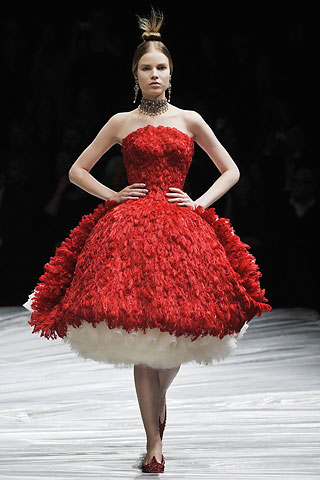
Daphne Guinness (in red dress)
Vogue Italia

Camus describes the human condition as a lived paradox. For him the way to live a genuine, or what I've been calling an honest life, is to accept that we live in conditions that simply are a paradox--that at a foundational level what it is to be human is to have to face two irreconcilable conditions of human existence and refuse to deny either one of them or attempt to reconcile them either. We must dwell in what seems like an impossible state of accepting an apparent contradiction. For Camus, this contradiction is found in relation to the simple reality that we do die. He states that to be fully alive in our human condition we must face the very real reality of our death and refuse to live it now. That is, we must accept that we will die and as a result here on earth we will also eventually be forgotten, but perhaps more importantly, each and every one of the projects we take up now while we are living will come to an end. Our investment in them will be as naught, even if someone else takes them up for us after we die--our own investment in them will be over. We will be gone. In a certain sense that makes everything we are invested in now meaningless--when we measure our lives against an infinite horizon it is as if we cannot even be seen to exist. Still, the truth is, here we are very much alive, panting and heart-beating our way through every moment of our lives right up until that very second in which both our breath and our heart stops. These moments of breath and heart belong to us and to us alone. That is NOT to say our lives are isolated to us alone and that our choices impact no one. That IS to say our lives are ours to choose what to do with and those projects we choose to invest in (including the people we have relationships with) are precisely what make our lives utterly meaningful. That is, we decide. We make our lives meaningful. It is not some pre-determined future we are working our way towards--it is us right now in our choosing. Camus describes this state as living in acceptance of our mortality without being resolved to it--that is, we face everyday the knowledge that we will die, without resolving ourselves to the limitations it might seem to imply. We accept that we will die precisely to demand we be alive now.

We make our lives meaningful. This is true whether we are my dear friend Kim that I featured part way through my 30-day iconic photo challenge--a woman who lives every day in faith, fully committed to raising two beautiful kids with a rambunctious adorable dog and a loving husband--or whether we are Marilyn Monroe, a woman whose persona was shaped in, in response to, and in a sense for the public spotlight, but whose life, nonetheless, was chosen and successfully expressed as a pinnacle of that Hollywood glamor. In both cases we find women that everyday wake up and re-choose their lives, determining in this sense for themselves the meaning it will have--both, strongly in relation to the effects of their own lives on other people, but the choice arises nonetheless precisely from themselves.

Similarly, Daphne Guinness everyday chooses a life that expresses another aspect of the human paradox--that we can reshape how we are taken by others, how we appear to ourselves, and thus too how we are expressing the way we feel about being in the world, that our insides and our outsides are continuously co-creating and in interaction with each other.

Daphne Guinness
Vogue Italia 2010

Right now I rest in my own sort of paradox. I am here carefully trying to navigate the reality between my open heart and how it leads me to imagine a possible future with a man while at exactly the same time the practical realities of the situation would seem to point in the direction of a different possible future. I know many people would tell me the practical realities tell me to stop being involved. While I know too many other people that would tell me the feelings mean to change everything for the sake of continuing in those feelings.

I am saying that Camus is right--to live this situation genuinely I need to accept that both things here right now are true without resolving to pre-determine the conclusion for this situation based on either one. That is, I can't claim this situation means there is no possible future just because our everyday lives bring us in different directions. But I also cannot claim there is the brightest possible future just because my heart can't help but love him. To claim either would be to deny the truth of the rest of the situation.

What I do know is that in the midst of this I have gotten to live in and recognize my own heart more fully than I ever have before, even as I also recognize I do not know where all this will bring me even just next week. This will be true even if the daily aspects of this relationship end tomorrow.

Honourable Daphne Suzannah Diana Joan Guinness
image by Rene Habermacher

I don't approach fashion. Fashion approaches me.
-Daphne Guinness


He is quite obviously the love of my life.
-Daphne Guinness, on her relationship with French philosopher Bernhard-Henri Levy

The heiress to the Guinness Beer fortune, Daphne Guinness married the son of a Greek shipping billionaire in her early 20's. Together they had three children. It is understood that though in merely financial terms Guinness had access to practically anything in the world, the marriage quickly became quite unhappy for her, resulting in her living a rather limited personal life. To cope with the unhappy situation Guinness dove into the world of fashion accumulating what was already at the time a greatly admired collection of haute couture, and other unique pieces from the fashion world. She became known not only for her impressive access to fashion designs, but also for her own impeccable talent for showing such pieces at their best on her. As a result, she was named to the International Best Dressed List in 1994.

Guinness divorced in 1999. Though she initially took time to live in comparable solitude, her unique style eventually connected her to work as a fashion journalist and stylist for some of the most interesting and prominant fashion magazines in the world. Several years after her divorce Guinness donated the entirety of her fashion collection from the period of her marriage to auction with all proceeds being given to charity. When asked about the choice she said that though she had loved the pieces dearly, they were also associated with incredible grief in her life so that she was ready to start fresh and allow her previous grief to be transformed into a financial difference for others.

Several years ago Guinness befriended the French philosopher Bernard-Henry Levi. She has described their relationship as including a strong connection that she resisted initially, both for being wary because of her romantic past and because Levi is married. She has never had an inclination to date married men, even if there have been numerous opportunities. Over the years the two continued to bump into each other at various social events, and also then to simply choose to develop their connection further. Guinness admits a kind of contradiction to her relationship with Levy. Of it she says the following.

He is quite obviously the love of my life. My greatest sorrow has been the unresolved question of the state of our relationship. ...when things are real, and when there is bound to be collateral damage, you have to look at what's most precious. And that's love.


Wednesday, June 1, 2011

San Francisco Bay, Free Choice, and Being Lost Amongst the Waves

image found at thebesttraveldestinations.com

In December 2005 one of my closest friends killed herself by jumping off the Golden Gate Bridge. She was 54 years old and had been struggling with debilitating depression for over a year. She'd been diagnosed with rapid cycling bipolar disorder and anxiety. Initially she was prescribed medication for the situation and the medication made a world of difference for her in terms of both how she felt and how productive she was able to be. She went back to school, made plans to study Chinese Medicine, and was even excelling at math, something she'd never had the patience to work on. Then the anxiety medication stopped working. It caused a swing so severe she could barely handle just sitting in the middle of a classroom where she didn't even anticipate being called on by the teacher. Doctors decided to just increase her anti-anxiety medication. Her anxiety remained but she started getting so lethargic that she could barely move.

When all this was happening she was living in Santa Cruz and I had moved to Flagstaff. I was in the middle of having returned to school myself, and was working on raising a 4-year old on my own so the idea of traveling to another state to see her didn't seem possible. She called me to talk through what was happening to her and I remember thinking that her tongue sounded incredibly heavy. It was like she could barely move it just to talk. In that phone call she told me her lethargy was so bad she was starting to stay with her then 85-year old parents so that she could just lay on the couch while they took care of her.

Doctors began playing with her prescriptions. They'd change medication and tell her to just see how the new one went. To give it two weeks and then expect improvement. I'd talk to her and for a day she'd seem better. Then she'd crash again and things would get worse. Then doctors would change her prescription and the cycle would start again. The truth was, she didn't have health insurance and so she was never being seen by any one doctor. She'd have to walk into an urgent care clinic when things were bad enough and then reiterate by memory whatever she'd been taking and the new doctor would just prescribe her something else to try and then never see her again.

Over this same period of time she also became slowly more and more isolated from her friends. Because of the medication and mood changes her behavior would be erratic and people stopped wanting to be around her. She also went to her parents because it seemed they were the last people that would reliably be there, even if just while she lay on the couch.

After struggling in this kind of way, heavy tongued, without enough financial support, and slowly losing her social connections, my friend called me in August 2005 and asked how I was doing. I was on my way to start a graduate program in Montreal. She was staying on her parents couch and had just turned 54. One of the last things she said to me was that I was just at the start of my life (I'd turned 30), and she was at the end of hers. I didn't realize how thoroughly she'd meant that statement. We talked a while more and then when we said goodbye I heard her start crying and hang up the phone. Over the next four months I was busy with graduate school and raising a 5-year old girl on my own, and she stopped answering my phone calls. In early December she was dead.

Earlier this week a man waded into the San Francisco Bay and stood there in water almost up to his nose while around 75 people, including police and fire fighter 'rescue' crews, watched from the banks. News articles report that the man stayed in the water this way for over an hour and looked back at the on lookers several times. He slowly deepened his stance in the water, repeatedly looked back, and those on shore just kept watching. Finally, the voyeurs report that his body began floating. He'd drowned.

The articles report that so-called rescue crews did nothing because they were "hand cuffed by policy." Strangely, articles do not bother to state what these policies are. They do, however, explain that budget cuts had prevented any of those police or fire crews present from being trained on how to do water rescue. Based on this I am willing to charitably assume that the policy indicated must be something that keeps city workers from performing rescues they have not been trained to perform. None of the other 75 on-lookers, apparently, attempted any sense of rescue either. The horrible truth of the rest of this story, however, is that AFTER the man had died a volunteer (that is, not a policeman or fire fighter) waded into the water after the man's body and brought it ashore.

Let me be completely honest that the death of my friend is something that will never simply heal. It's been almost six years now and I have done, what I take, to be a kind of healing process around the grief so that the most immediate worst of it, so to speak, has been healed. Even so, her death means the loss of a real person's life, a life that made enormous difference to those that loved her, including me, even when towards the end some of that difference included painful challenge. The fact that she died by what we're inclined to call a personal choice makes the loss of her all the more painful--it highlights the pain and futility she must have felt. But it also highlights the failure of the people in her life to be able to help her adequately, and the failure of any of the medications or doctors that prescribed them to make a difference. The truth is, in a more ideal situation, she would have been seen regularly by ONE doctor that would have tracked her progress, her responses to various medical interventions, and tried, with her, to problem solve her situation. But, the medical community was handcuffed by money. She had no medical insurance.

Having said that, I will now say that the news of the man that drowned this week in San Francisco Bay deeply angers me. It is not only an anger that echos the pain of the loss of my friend, though I am sure that is there too. It is an anger over how this article reveals public attitudes about money versus life, policy versus life, and how it also reveals what I take to be a horrible misunderstanding in how personal choice factors into an action like killing yourself. Let me further state, that when I say "it angers me", what I actually mean is that in imagining my way into this story I feel immeasurable grief over the loss of this life, even if I must admit it is a life I did not apparently know.

News articles I have read in this man's death state that the so-called rescue crews did the right thing by not intervening in this man's suicide, even as they stood and watched it happen. The primary claim is that money (via budget cuts) and policy overrode their ability to intervene, and that because of this they were right to watch the man die. IF what is actually more deeply true here is that the 'rescue' crews were under trained and so unable to safely (within reasonable expectations--after all any rescue attempt simply isn't completely safe) attempt to rescue the man without seriously threatening their own lives, then I am sympathetic more or less to what a bad situation the crews were in. This has NOT actually been stated in the articles I've read, however. Let me point out too that the state of the water WAS apparently safe enough for a volunteer (that is someone NOT on the rescue crews and so obviously not adequately trained in the midst of budget cuts either) to wade in after the man's dead body once he'd finally drowned. This implies the water would have been safe enough for someone to at least go into the water, and indeed the man himself lived safely standing in the water for at least an hour BEFORE he drowned. I realize that things become more complicated if you're afraid that the person attempting suicide will fight you off in the water. But the articles imply no one actually faced this possibility--that is, no one entered the water after him.

When interviewed about the situation, an Alameda Police Lieutenant stated that his men had done the right thing. He explained that the situation was difficult because, as just discussed, his men didn't know if the suicide-victim would try to fight to preserve his own ability to die. He then also stated that his men were in the right because the man was in a deliberate attempt to take his own life. In this way the occurrence was not a typical rescue situation.

San Fransisco is known for a history of passivity in regards to suicide. The Golden Gate Bridge, and as a result also San Francisco Bay, has been one of the biggest suicide magnets in the world since within a year of its completion, and is in fact now considered THE biggest. Though it was originally designed to have sidewalk barriers far surpassing the height of any individual human, the designers in the end decided that such barriers would impede the glorious view of the ocean on one side and the bay on the other. As a result the barriers stand at no more than four feet. For almost a century, there has been public discussion of whether to install suicide barriers BELOW the sidewalks. Such barriers would make it impossible for anyone to successfully jump from the bridge and thus commit suicide through the equivalent of a twenty-five story fall (746 ft; 227.4 m).

During public debate over the possible installation of a suicide barrier, and interviews of the public done by the local papers, or surveys done as a study of people's opinions, there has been a strong tendency to claim that a suicide barrier should NOT be installed because suicide is a free choice people make, and as a free choice the right to make it should be maintained. There has often then been a follow-up claim made that if a person doesn't commit suicide on the bridge they'll just do it in some other fashion instead.

The easier point to respond to is the final one. There have been suicide magnets all over the world and studies have shown two things--one, when someone jumps from a suicide magnet (like the Golden Gate) it is OFTEN the case that soon after someone else will also jump. That is, suicides off a suicide magnet spawn copycats, thus increasing the numbers of deaths. This is not true of someone committing suicide in their own home, as a counter example. Two, studies of suicide magnets around the world that have had a suicide barrier added have actually shown a HUGE DECREASE in suicides in the extended area AFTER the installation of the barrier. That is, it is precisely NOT the case that someone that doesn't jump from a suicide magnet will just kill themselves in some other way. Instead, it seems to be that death is just too easy and too guaranteed off of something like a bridge that rises 25-stories above the ground. Other forms of suicide are more messy, less guaranteed, and also less attractive.

Finally, I want to respond to the idea that suicide is a form of free choice. In doing so I want to say that I am a huge proponent of our American ideal of 'liberty.' I support the idea that our right to choose for ourselves what we shall do must be maintained. However, making such free choice depends on HAVING THE ABILITY to choose freely. Further, having such free choice does not actually remove us from ALL societal interventions or judgments in regards to the choices we want to make.

Experts have shown that such ability is dependent on having what we call competence. That is, an individual must be more or less mentally clear and stable, and not overly constrained through external influences and strains such as excessive social pressures, radical change in ones personal circumstances, untoward familial influence, or impactful physical impediment. That is, even people that are more or less competent can have experiences of extreme stress that cause a severe enough effect on their condition that we could say that they are not competent temporarily as a result of some recent occurrence. As an example, years ago during one of the stock market crashes of the 1980's, loads of stock brokers killed themselves by leaping from their own sky rise office windows. Most had likely been what we would consider thoroughly capable of making decisions for themselves right up until the stress of the stock market crash. In fact, it would seem that the successes they'd had up to that point in investing money, maintaining their jobs, and reaching that pinnacle of career position, would all indicate that they were more or less competent. Why? Because each of these things just listed are all complex decisions that must be made and followed through on by an individual--the ability to make complex decisions and follow through on them is precisely what competence means. Then, in facing the radical change in circumstances caused by the crash, plus the social pressures of the money they'd lost themselves and for others, plus who knows what else, we could argue they were no longer thinking clearly. In this kind of way whether they were competent, and thus making a truly free choice when they leapt from their windows is highly (excuse the pun) suspect.

Experts that discuss competence also emphasize that competence is actually relative to a circumstance. So, the more serious the potential consequences of a decision, the more thoroughly we want to ensure an individual's sense of competence as they make that decision. So, if the free choice you're making is whether to eat a chocolate chip or ginger cookie, it seems the consequences are fairly low, so even someone with a condition like schizophrenia, which might lower someone's overall competence, could still be seen as competent-enough to choose a cookie for themselves. However, a decision like driving across town safely in a car might be seen as having much higher potential consequences, and thus much higher demand for competence, than choosing the cookie. From this view, we see, then, that the highest demand for competence comes from a person deciding about life or death. The reason, obviously, is because the decision is absolute. There is no repair from death, like there might be from a poorly chosen ginger cookie.

With all this in mind, I think it is at least THEORETICALLY possible to make a competent decision to die intentionally, but that such cases are rare, and possibly so rare as to be almost impossible to find in actual life. When it comes to judging whether someone is competent, the demand is highest in cases of death for the reason already described--the decision is absolute. The truth is, judging competence is precisely when we see the limit of an individual's right to choose for themselves. Here we see the reality that our liberty is intertwined with society. We cannot always judge for ourselves whether we are making a competent decision. In the case of choosing death, if we are suffering under radical, sudden, or debilitating change, we might not be able to see clearly enough all there is to live for.

The man in the bay, unfortunately, is now lost absolutely. As is my dear friend that I will always miss. It is too late to rethink what we can do in the face of their despair. We can try harder to honor their pain, however, by questioning our public views of the value of money or policy over life, and of reconsidering if we value our liberty so thoroughly that we misunderstand when we genuinely have it. People on the verge of suicide must be questioned in regards to their competence. And as we stand, firm footed on the shore, seeing them standing amidst the waves, we must work harder to act before they are lost among them. Before they are lost in the absolute.

Tuesday, May 31, 2011

Meditation on Love and Mothering

The truth is there are days when I can barely breathe. When the reality of trying to balance my finances, keep afloat in my job, maintain my house, have food for the hamster, the bird, myself, and the girl feels like too much. It's the reality of doing all this by myself while with and for my kid that tightens my chest and makes me question everything.

Years ago I got pregnant unexpectedly. At the time I knew I'd just keep moving forward with it. That I hadn't planned to have a baby but that now being in the process I'd rise to the occasion. Growing this kid now 12-plus years on my own has made me rise higher than I had any idea of, higher too probably than I would have as a single independent person.

Still, there are times when I struggle with just standing up one more time. When the truth of dealing with life's everyday stresses for the sake of two people but with only the psychic support of myself feels just like too much for me.

I am an only parent. I am a mother. I am responsible for helping this young girl grow a healthy heart and a capable sense of determination and growth. I must too plan for her physical future--make sure she eats a fairly balanced diet, make sure she develops the habit of brushing her teeth twice a day and flossing too and rinsing with mouthwash, of not eating TOO MANY cookies, of getting proper immunizations, and of learning to appreciate vegetables. But then too, in many ways, I am also responsible for her joy--for helping her see that in the middle of stress we can be goofy, that it's good and possible and fun to laugh spontaneously, that we can revel in the simple everyday things, that if we rinse our dishes right after using them, whether we're going to wash them then or later, our day will be happier.

Lots of literature on the emotional health of a person states the idea that it is through our relationships that any of us grow the most as a person. This same trove of insight also tells us it is in our relationships that we most deeply heal our own hurts. Sometimes we think we must do it on our own to be ready for another. But it is the other that opens the door more widely for this process to happen.

I was surrounded by family growing up. I was raised in a multi-generational family. There was always someone there. Still, through no fault of anyone, I grew up lonely. My heart felt separate and not understood. As an early teenager I could feel I had the power of invisibility. There were moments when I would intentionally exercise it--turn the power on and off. I remember sitting in the middle of a ski chalet surrounded by people I knew. I said to myself, "I choose to be invisible. I choose for no one I know to see me." And for ten or twelve or eighteen minutes I sat there as people I knew walked by urgently on their way to whatever task they had. Not only did no one stop. No one noticed I was sitting there. I smiled at this then decided "okay, now I will be seen." within a minute people walking by turned heads and smiled at me, waved, or came and spoke with me. It was not the invisibility that was a problem. It was feeling I could control it. That sense of power seemed alienating.

Now I have a daughter. She is a glowing beacon. She is happy. She loves what is around her. She loves me. She wants to revel in the richness just of being close to others and of exploring projects that she likes. There are times I want to hide. But I've lost my power of invisibility. There is no off switch any longer.

I spent much of my life doubting myself. I do not take credit for being a parent and yet I know that her being a glowing beacon. Her being happy. Her loving what is around her. Her loving me. All these things indicate NOT that I have made her these things but that I have succeeded at holding a space through which she can be who she is, in which she can be these things. She is a person. So she is also sometimes sad. She also feels pain for others. She also gets bored. She also wants to connect. That is, she feels a wanting. My job is not to take these things away from her. That would be to deny her who and what she is, a human. My job is to provide her a sense of courage, and to offer her a gift of steps--ways to dance in the feelings.

I spent much of my life wishing for love from another. This comes from the loneliness I mentioned as a child. In the movie DOGMA the character Bartleby is an angel that was kicked out of heaven. At a moment of breakdown he says that ever since he has felt that absence of the divine and it has been as pain to him. I believe this is a description of that feeling of wanting the love of another. It is not just actual relationship with another human that we feel we want when we have that longing--it is our own absence of trust, of faith, of openness to our being alive and the richness of all that is that compels us to seek connection in others. We reach out to find a moment of our own faith again. We reach out to recognize ourselves.

My daughter has pushed me everyday to recognize she is there wanting the same thing with me. It is a source of pain for me. Part of who I have been is someone that is invisible, that experiences herself as alienated. To change that is a kind of healing, but to heal is also to painfully remake myself as well. Healing, opening to the gift of others, is not an easy gift. Some people believe that when love arrives our lives will be better, or we will be happy, or it will give us what we've been looking for. This can be true. But the further truth of it is that it is also us that must be willing to suffer the pain that will come in the quiet glory of truly recognizing the joy we can live through love.

Tuesday, February 15, 2011

In Loving Memory

Earlier tonight, in the midst of watching a movie focused primarily on humorous moments, I suddenly flashed to a funeral I hadn't thought of in years. There is no real way for me to explain how or why this odd association happened.

My grandmother died unexpectedly when I was 19. My family was, for a long time, broken by grief over it. Within six months her cousin had also died, his death expected, due to cancer. In the midst of an otherwise pleasant movie there I was suddenly overcome with a flash memory of this same cousin, far too thin from his illness, struggling to make sure he fulfilled his roll as a pall bearer of my grandmother's casket. At the time I'd thought someone should help him with the weight of his corner of her wooden box. He was determined, however, to do her the justice of his care for her by being one of the men that would usher her from the church and into the ground.

My grandmother came from a remote and small town on the Western coast of Alaska. Her death was so unexpected it was a grief the whole community struggled to bear. We met for her service at the largest church in the area and then a caravan of cars several miles long drove out of town to the cemetery for the burial, and then later back to town for a potluck with everyone from the village, and others across the river, more across the bay, and still more from up around the neighboring lake. The food came from people's winter cache--berries they'd picked late in the summer, fish they'd dried at the start of it, moose meat they'd hunted that fall. Everyone shared the best they had. It was a grief we all understood together--the shock of losing such a vibrant, laughter-filled woman when no one had for even a moment expected it. One of the sad truths of this experience is that the town was good at handling funerals. Life in remote Alaska includes many deaths.

My family was met at the airport and driven to our home there as we all flew in from various towns around the country. We were met without ever having to ask. My sister and I drove across town from the airport in the back of a suburban, each of us with an arm propped up on my grandmother's casket. The suburban the town's makeshift hearse. My grandmother's body was, of course, inside and though the thought of flying on the same plane as her casket had somehow bothered me, the thought of riding across town in some other car to let another person sit in the back pressed beside her box that would later be lowered into the ground was unthinkable to me. So my sister and I sat there, each on opposite sides, leaning against my grandmother's coffin in a moment of being close to her.

It has been not quite twenty years since my grandmother died. One of the remarkable elements of such memory is in how emotionally vivid aspects of it still are. The truth is, I still grieve for her in many ways. The simple thing to say is that I miss her. Then, other elements of the same overall experience are almost lost to me. I do not remember them, and some I would not even if I were reminded of them by someone else. The moment of my cousin using the strength of his skinnied body to carry my grandmother's box from the church, for example, I had in no way thought of since till suddenly, inexplicably, a movie triggered its flash again in my mind.

My friend Aeyn Edwards died at the start of this new year. The truth is I haven't talked about it much, though I've mentioned to people a friend of mine had died. He was four days shy of 31. He'd survived leukemia almost three years. He'd survived immeasurable grief from his partner and father dying, both suddenly, and then being diagnosed with a life threatening illness while living alone. When his partner was still alive they'd traveled to Peru, met a teenager that was struggling to afford an education and responded by financially sponsoring him for the remainder of Aeyn's life. They also continued to stay in contact with him, and did what they could to return for visits and support the youth as he developed in such goals. In the midst of challenge, Aeyn persisted with incredible grace and passion for life. He readily admitted his own fatigue, his own grief over the difficulty of his challenges, but he did so with a kind of honesty that in itself, while painful, was also a blessing. Having said all of that, he is someone I have a hard time explaining except that his care for others, and his care for his own life too, was inspiring. And that the fact that he wished to be my friend has been one of the most meaningful blessings of my life. I care very much about wanting to be a good person. Somehow Aeyn caring about me reassured me that I must, but also that I could be one. His friendship was a reminder of how important it is for me to care in similar ways as him. Something I already knew but that was ever highlighted by Aeyn's beauty and strength.

For several years now I've said that the thing about grief is that it does not belong to the person grieving. Instead, he or she is just the means through which grief is possible. Some of what I mean by this is an allusion to the inexplicable nature of grief--that it comes when you might not realize it will; that it owns you in a way you cannot undo while it is there; that it isn't yours to grasp or hold on to, instead only to feel and let flow through you.

I used to think too that grief was something that would leave a person after a time, when it had been "worked through," so to speak. That if you faced your own grief over a person's death you'd get over some major portion of it. But I realize now such a view is mistaken. To think that grief is something that needs to be worked through or overcome is to see it as a pre-determined, or hard-sided thing that can be studied, or changed, or manipulated, or even expected and planned. Such a view is to see grief as a kind of object that can be held onto and changed, instead of recognizing it as a supple, flowing state that we encounter and cannot shake, though it will in time shake us. And then perhaps again return. Grief does not belong to any of us. We do not get to decide how it will go. It is a soft and flowing presence that appears as it will, based on its own demands. Holding onto it is a kind of abuse of what it is, a way of trying to demand it belong to you and be firm, when it cannot, and when doing such holding harms any of us more than letting grief flow would too.

Much of the time I avoid talking about those loved ones that have died because my sense is that most people are uncomfortable hearing about such things. Many of my friends regularly tell me they haven't experienced very much death. They say this and then say they've been lucky. The fact that I have, then, makes me alien to them, even if they love me, as they can, in the midst of it.

In the midst of very much missing Aeyn still, and, surprisingly, feeling fresh pain over even an almost-20 year gone passing of a loved one too, I can only think there is no luck in avoiding death of loved ones. Instead, I realize that the truth of my list of lost loved ones being long means I have been incredibly lucky to have loved such that I can feel grief now. The grief now is part of the love then. It implies a connection with someone deep enough to cause pain when it goes away. I am grateful for how such relationship has shaped me. I am grateful too that in being visited by grief, even as it does not belong to me, I discover too that the loved ones I miss are not entirely gone. They have lost their own bodies and become, like grief, something soft, and flowing, in memory through me.


Sunday, December 12, 2010

Revisiting Decision Making; or, A Letter of Recommendation for Pneumonia Sent to All the Top Employers in the World (you know, YOU)


I want to revisit a post I made at the beginning of November while in the throws of pneumonia. (It's mostly gone now, by the way. The truth is, it turns out, that pneumonia takes a month and a half at least to heal. My arms and legs are skinnier than I've ever seen them. But that's what comes from laying in bed so long. There's an occasional crackle in one lung, but rarely, and I also still have a cough.)

The post I want to revisit is one where I discussed the *way* we make decisions, and said that in making my decision to come here to the Northeast United States I'd made a mistake. I think there's an important distinction to make there--between the process, and the outcome of the decision.

It's a distinction that I made in the original post, but that I didn't highlight enough at the time. It could easily seem that the subtle difference might not ultimately matter that much--that we end up having to figure out what to do in the end anyway. Truthfully, I think that even had I gone through my decision making process about whether to move here or not in a different manner, the right choice STILL would have been to up and move all the way across the country to New England. So, why the heck do I care, then, to belabor the point about *how* I went about getting here at all?

It's clear to me that in my actually coming here to take this fellowship I made no mistake. In many ways, some of which are only obscure and esoteric, coming here was exactly the right decision. So, wonderfully, I have no regrets in my being here, or in my having left Northern Arizona when I did either. The mistake I made was in not well enough considering my own feelings about what I was doing. By overlooking those feelings I also missed my opportunity to learn something crucial about what I valued in the life I was living, and so then too something crucial about how to enact those values as I shifted to making a journey into the ivy league (so to speak). To put it another way, by not acknowledging well enough how I felt, when I moved I ended up metaphorically leaving myself behind. That is, I basically arrived in New Hampshire without my heart--not in any romantic sense, but in the sense of having a connected, genuine relationship with myself. As a result, a move that would have been challenging no matter the circumstances occurred with me being hollow to myself.

One of the surprising truths of this whole experience is that I'm deeply grateful for how awful most of this Fall has felt, and deeply grateful too for having gotten pneumonia so virulently (I had to have a second round of antibiotics that included both intravenous AND oral treatment because three weeks into it the symptoms just weren't getting better). It turns out being uncomfortable in so many different ways all at the same time I was forced to take a look at WHAT WOULD make me feel better. After a point I couldn't really do much to help the physical discomfort of being ill, and being stuck in bed meant that after a point I also couldn't really do anything to counter a sense of isolation either (the internet really does only go so far). Pneumonia takes a long time to heal, so after some point I just couldn't really mentally fight the idea that I was ill and alone anymore. I just had to accept it and then find out what I was going to do to deal with it.

Pema Chodren discusses the buddhist idea of the wisdom of no escape (in fact she also has a book with exactly that title). In thinking through the insight we come to see that much of our life is spent developing various forms of diversion. We practice distracting ourselves in various ways again and again out of a kind of avoidance of the simple reality that right NOW right this minute we are alive. The thing is that the simple awareness of our living is actually a radical awareness. For many of us it brings a variety of emotions that are hard for us to deal with, like inordinate fear, or incredible grief, or shocking lonliness. Such feelings, though, are hard to deal with in many cases simply because we're not used to dealing with them; that is, we are resistant to being uncomfortable in ourselves when it can be avoided, and so we do avoid it when we can. (Let me not be taken here to discount the very real challenge of actually going through such feelings as strong grief. It can be severely uncomfortable, and in no way do I want to deny that.) As a result, any of us end up living our lives avoiding feelings we're afraid of, and also avoiding making decisions we're afraid of. We cultivate distractions that we're invested in maintaining, even while paradoxically not actually investing ourselves in those activities. Activities ranging from that drink at the end of the night, to the television show we don't quite like but keep watching anyway, or by staying in the relationship we're not actually happy with but are afraid of leaving. None of these particular activities--having an occasional drink, watching a television show, or being in a relationship--in themselves is any sort of problem. Instead, it's the *way* we engage in them that could be a problem, or, conversely could reveal the very richness of our self and our lives.

Once we recognize how much of our lives is actually just pursuing distraction, we can begin to see where there could be a moment instead of no escape. The wisdom of no escape is in facing those very moments we want to just metaphorically run away from, and in so doing find ourselves in the midst of those very feelings we've been avoiding feeling. This isn't to say we should stay in a situation that really is bad for us, obviously. Instead, it's saying that sometimes just staying still is necessary to genuinely recognizing ourselves, and connecting to the possibility of living our lives with an awareness deeper (and larger) than those uncomfortable feelings. The buddhist insight is, of course, (at least partially) that in doing so our sense of what matters to us, what we want to invest in, what we are attached to, and even who we are changes.

The gift of my having been here in pneumonia-ville for so long, also in a town where I honestly didn't know anyone that could visit me during the illness, has been that I was put, whether I was willing or not, directly into that space of no escape. I could psychologically fight the situation for a while, but after some point I was simply too tired even for that. Somewhere in there I had to just accept that I was stuck in bed with no where to go and no one to spend time with besides myself.

This last week a friend of mine described for me an idea of what she called "wise mind." The image that illustrates wise mind is a simple one. There are two equally sized circles that overlap in the middle. One circle is "reason" and the other circle is "emotion." Where the circles overlap is "wise mind" and genuinely made decisions, and balanced living come from operating in that overlap of circles--deliberation that takes both reason and emotion into account. Looking back over my own life I recognize that in some sense I came out of my childhood operating strongly on the "emotion" side of the picture, then I went to graduate school in philosophy and flipped to operating primarily out of the "reason" side. The trouble is BOTH are needed, and reacting to the limitations of one by jumping over to operate only in the reality of the other is just as imbalanced and limited as where the situation started. The mistake I made in how I decided to move here was in choosing from the awareness of only one of those circles without living clearly enough in balance with the other. So, it turns out that even if I ultimately made the right decision by moving here, I made that decision without wisdom.

I arrived here in the Northeast United States and for the first two months of my time here (before getting sick) felt personally uncomfortable, like I was being squeezed tight by the choice I'd made to live (even if temporarily) in a place that felt quite simply like no match at all to me and what I care about. Even with the truth that this really is a wonderful place, with incredibly kind hearted and generous people, a lovely foliage, and pleasant range of offerings--still everything here feels *for me* like I'm being pushed out. To put it another way, I don't recognize myself in any of my surroundings. Again, the problem with this place for me is not in the place itself. The place is a very very good one. The problem with this place is in its relation to me. What I value and want to be able to engage with on a daily basis isn't readily enough found in this place for me. It's simply a mismatch for who I am. So, trying to live in that, trying to force myself to "just adjust" or "just open up to it more" or "just find places I like to hang out in" or "just go to that social event to be around people even if I don't want to" etc--all of that felt like me being squeezed alive by my own discomfort. Trying to make myself do all that stuff to "just adjust" also amounted to another example of ignoring healthier ways of making everyday level decisions for myself. What I needed was not to force the situation on myself because I should meet people, of hang out more, or get used to it, or whatever else I'm apparently supposed to do to deal with feeling out of place. What I actually needed was to get into a clearer sense of what I wanted to do to deal with my discomfort--to recognize what was making me so uncomfortable, and find within my own engagement with it that balance of reason and emotion so that I could both feel my discomfort and think-feel on what was right for me to do with it.

Being forced into bed by pneumonia and having to just live with the situation I was in, I had no real choice but to lay there rolling in my own uncomfortable emotions, being cuddled by my own anger that I'd moved here at all, being loved on by my sense of anguish that in many ways as a single parent my life has been inordinately hard, and here was just another example of that difficulty. I was stuck not just swallowing antibiotics everyday, but swallowing the reality of these various feelings too. The incredible gift of having to just learn how to recognize those feelings, and as a result also discover my own relationship to them was to realize that as stuck in my circumstances as I felt, I actually have a huge range of choices that can be made. As a result, I've found my way to making decisions about what to do in the face of living in a place that's felt so uncomfortable for me. In my previous post I said I'd have to sort out what to do in the face of my decision and that it would likely take some time. I've arrived now at a place where I am more clear what to do about it, and am implementing those decisions to make changes that matter to me. (I'll discuss what I'm doing in that regard further in a future post.)

Buddhists, and existentialists and radical feminists alike (though in importantly different ways) remind us that we are all constrained by the circumstances of our lives. This is simply true. And it is within those constraints that we discover the very possibility of creative engagement; that is, it is in the moment of recognizing our own constraints that we get to take up the question "and how are we going to negotiate that? what are we going to do with this constraint?" We are often tricked into believing that the answer to these questions is already given to us--well, I'm a mother, so I have to do this and that. Or, I already have this job so I must do these several things. etc. There are innumerable examples of how any of us assume we simply must do things in our lives in particular "obvious" ways. Sometimes in reaction to this feeling of obligation we day dream over the idea of radical freedom--our lives changing dramatically so that we become something like different people living incredibly different lives (winning the lottery, perhaps). But genuine freedom comes in the simple choices we make of how to operate within the circumstances of our everyday lives. We might strongly remake our circumstances by moving across the country, for example. But we can also (and probably more often) recognize the intersection of these two ideas--no escape, and wise mind--as bolsters for discovering greater freedom in the life we already have.

This morning I am making innumerable choices. I have chosen already to reflect on these ideas and write about them here, obviously. I also chose to SQUEEZE my girl-girl and feel the gift of that goofy relationship, while jokingly telling her not to pee on me (to which she laughed). I am also going to DRINK my coffee and imagine I can chew it up it tastes so good, and also eat a grapefruit. I like the way grapefruit makes my insides feel--like everything in my stomach has puckered slightly with the reality of that vibrant taste. Hey! Have you ever smelled the skin of your grapefruit before you cut into it? Do that. Then scratch the skin of it with your finger nail and smell it again. Close your eyes as you do this. It's a simple moment full of a vibrant, sharp brilliance that I love. Even if you hate it, what a moment to be had.

Thursday, December 9, 2010

I Am A Puppy

Two seemingly very different moments have come together powerfully for me today.


My Very Favorite Book as a Little Kid

First, I was messaging online with a friend about how we make decisions in the midst of outside pressures. Both of us are in the process of choosing to do things that from some perspectives could look like a mistake--choices that mean changing significant outer elements of our lives.

In talking about this I made a joke to my friend that I wanted them (I'm being gender non-specific on purpose here) to know that if they changed their mind and chose NOT to make a big change, I still supported them. That, in fact if they decided to become a puppy, for god sake, only because they knew it was what was right for them to do with their lives, then EVEN THEN in the midst of SUCH radical change, I still supported them. It seemed to me, I said, that becoming a puppy would be a real challenge, but that the point of all this, as far as I could tell, was learning to choose what is right for ourselves even, and in fact especially, in the midst of outside pressures.

Later, the friend wrote me back describing some of those outside pressures. Their experience left me saddened--saddened that people sometimes find it appropriate to respond to each other in ways that intentionally diminish the other person, rather than in ways that could be seen to bolster each other EVEN in the face of decisions we might disagree over. I mean, we can disagree about something and seek to dialogue in the midst of it for the sake of BOTH coming out of it better and clearer people, rather than taking an approach that includes attack or discounting either person. It seems too often that real change happening in one person's life appears as threat of some sort to another person, and so the change is met with defense and attack, instead of the open-hearted stance of understanding, or at least striving to understand.

But, in the midst of thinking on the unfortunate response one person took up with my friend, I had an epiphany.

That is: turning into a puppy is actually no significant challenge at all. Really. Because, you see, what a puppy really is is simply a being with a wiggling heart SO CERTAIN of its own sources of joy that when in proximity to those joy-making-things, the puppy's heart can't help but warm SO GREATLY that its entire body vibrates in pure expression of that joy. In this way, a puppy is an incredible, adorable, infectious barometer of love and joy (that, admittedly, sometimes makes messes in the midst of its uncontrollable determination to explore the world in happy exuberance).

Heck! Put that way, I can be a puppy indeed!

In fact, I AM A PUPPY.

I've decided. I made a decision to change the rest of my life today. From this point on, I am a puppy. Voila!


Second, I was emailing with a friend of mine about the upcoming funeral for Elizabeth Edwards. Though I have no real attachment to the idea of Edwards, still, it is an event that holds sadness.

We were discussing the confusing, and hurtful response by a small but determined baptist church group led by Reverend Phelps that intends to picket Edwards funeral with messages of hate. My heart was pained over such an idea--the idea that there are such strong pockets of hatred in the world that people would choose, for example, to enact it in the midst of someone else's most tender grief. Focusing directly on these negative realities can be incredibly demoralizing. Sometimes it feels at worst hopeless, and at best confusing about what can actually be done to respond.

Eventually, the friend emailed back with a link to a salon.com article about this same group picketing outside Matthew Shepard's funeral back in the late 1990's. At that event, however, an incredible thing happened. Here's a quotation taken directly from the salon article,

"But Phelps' contingent was surprised by a parade of Shepard sympathizers dressed in white angel costumes 7 feet high, with 8-foot wingspans. The "Angels of Peace" quickly surrounded his group and smiled silently at the crowd, which enthusiastically cheered them on."

Reading that, I was overwhelmed, and I realized--that is what I want to do with the rest of my life. I want to remember that hate, diminishment, and disregard for each other really can be overcome by an earnest enough expression of beauty, and love, enacted through grace. Sometimes it takes a number of us banded together in our commitment to be such angels on earth to make that difference. Often we can inspire such earnestness in each other, thus finding that band of loving angels more readily.

How to do that exactly changes depending on the situation at hand. But I appreciate the example the "Angels of Peace" offer. None of us should ever have to be confronted with signs of hatred as we face our deepest grief, as we must in the midst of a funeral for a loved one. What Phelps group is doing is simply wrong. It takes up, unfortunately, a common misconception of what morality amounts to--a twisted exercise in control and damnation, when the more heartfelt reality of ethical considerations is simply that our moral choices are a reflection of the genuine grace we can share with each other. Finding such a creative approach as enacting a vision of divine love through enormous angelic group costuming is a brilliant expression of how the only demand on us really is to simply think and act beyond the expectations outside pressures have placed upon us.

I am grateful to take up the dramatic example given by the "Angels of Peace" here--that in the face of others skewed and hurtful responses to our own best choices for our lives, or our own painful moments struggling with grief (both examples of our own human reality, in other words), it is possible to respond with overwhelming, humanity emboldening love, stepping out like an angel here on earth, which incidentally sometimes really does look just like a 7-foot tall, 8-foot wide, white feathered angel, or other times just like a puppy.

Sunday, November 21, 2010

Simple Pleasures

The honest truth is that it's been pretty hard for me to remember what kinds of things actually make me feel happy. The simple reason is that I've been pretty exhausted since we moved here, and it can be hard to have fun when your body is wiped out. The other reason is one I've talked about on here already, which is simply that this place is a kind of mismatch for me that means it's hard to recognize myself and what I enjoy in our surroundings.

Yesterday I had a quick moment that was actually one of only a few times that I've felt simple joy since we arrived. The idea of being unhappy for the entire autumn sounds horrible, I realize. But, recently getting some of my energy and self awareness back after having gotten sick has allowed me to recognize that what I've just said is true. Recognizing that I've been unhappy in such basic ways--that it's hard for me to even come up with what I like to do--has helped me shift my focus to getting more aware of what I would like to do in simple day to day circumstances. This weekend I've been making a point of uncovering the answer to such inquiry within really really basic decisions.

Here's an example. Yesterday after taking the little one to her horseback riding lesson we stopped at the local co-op grocery store, which has become a kind of weekly tradition. We use these co-op stops to pick up the basic stuff we happened to run out of over the week--sandwich bread, soy milk, etc. Yesterday the 11-year old was feeling tired enough she wanted to stay in the car while I went inside. So, I walked into the store on my own running through a list of things in my head that I wanted to remember to buy. Going through the area where the carts and hand baskets are kept I asked myself a simple question--do I want to get a basket?

A cart seemed too big since I was only getting a few things. The rest of the story is that I actually hate pushing carts around. When my girl was a baby I usually opted to carry her in a pack rather than push a stroller. When I go to the grocery store I'll often opt to carry a hand basket rather than push a cart even when the truth is I'm getting enough stuff that using the hand basket is going to turn into a crazy exploding over the top balancing act of fullness. It turns out this dislike of carts extends actually into a dislike of hand baskets too. I consistently want to opt for the smaller option. So, if I'm getting just enough to fit into a hand basket I'd actually rather go without any basket at all. There are times when I will reasonably grab a hand basket even though I'd rather not. But last night as I entered the store I decided I didn't want a basket at all. I thought I was getting only just enough stuff that I could manage carrying it myself.

So, I went around the store grabbing our grocery needs and then carrying it in either of my hands, and then eventually my clutching arms too. 2 full size containers of silk original soy milk. 2 large size containers of Brown Cow plain cream on the top yogurt. 2 bags of whole grain English muffins. 1 bag of whole wheat sandwich bread. 2 boxes of Ezekiel flax and grain breakfast cereal. a 6-bunch of bananas. 1 box of oat milk. None of the goods were consistently shaped in a way that allowed me to simple stack and carry. Instead I had to juggle around with delicately balancing clumps of items in my intertwined arms and then carrying other things in each hand. By the time I grabbed the last things--the bags of bread--it was a little touch and go to simply pick one more thing up. I had a balancing act going with the items in my arms but then moving enough to wrap the bread bags between my fingers was hard going. Still, just the simple act of making this work was the most fun I'd had in a long while. I liked how it was kind of absurd that I was bothering with this approach paired with the knowledge that I'd be able to pull it off.

I grew up commercial fishing for salmon and one of the skills I had to learn through it was getting as many salmon in each hand as possible in order to then carry them across the mudflats to the beach where the fish would be sold. By the time I hit my teen years I was able to carry 7 fish in one hand by threading my fingers up the gills and out the mouth with a couple fingers carrying 2 fish at once this way. As a result, for much of my life I had incredibly strong hands. These days I have no reason to ever carry fish in such ways, but I still entertain myself occasionally by carrying as much as possible in one hand. At the alternate universe costume party that Shiloh had last month I ran around at one point with a pail, a tambourine, 3 champagne glasses, and a bottle of wine all in one hand, and then one glass in the other. I love pulling a silly prank like that, even though it is almost entirely only for my own sake. I don't tend to point this feat out to others.

So, anyway, in the grocery store I finally got the last of the items all balanced in my arms and hands and then trudged off through the aisles hurrying to the check out stand. No one in the shop paid any attention to the mountain of products I was carrying. But I pushed between people anyway smiling to no end with myself. I was enjoying my own silly project of stacking and carrying. Then just before I hit the last aisle before the checkout counters a man stood between me and the way through. He looked at me, feigned shock, then jumped dramatically out of the way for me and watched with an enormous and warm smile as I hurried past him also smiling. He shared in my amusement and watched me go past, apparently simply because he could tell I was there in that moment having a good time.

This last week news reports have covered results of psychological studies recently released that claim excessive day dreaming actually has the effect of leading to depression. Most people, apparently, spend more than half of their awake time thinking of being somewhere else, either imaginary or real. They also claim that the study seems to show that it is when we live in the moment that we feel happier, and the more we can practice increasing that kind of time in our day the happier we can feel overall. None of us can help but day dream, and it would seem there is some utility and joy in it. It's just when we overdo it we become unhappy. I take it my grocery balancing routine was a silly little expression of living only in the moment of pulling the small but entertaining-to-me-and-the-man-in-the-aisle feat off. I had to concentrate on keeping all the variously shaped items precariously balanced with each other in order to avoid a disaster like yogurt hitting the floor and exploding all over the chocolate aisle.

With that kind of live in the moment happiness in mind, it occurred to me that it could be good to help myself remember what little things make me feel good by simply listing some of them here. The revealing thing about the grocery store balancing act though, I think, is that it came very much of its moment. It isn't the case that I'm guaranteed to feel tons better any ol' time I try it. But, even so, I can also remember that I tend to like to do that kind of thing. With that ammunition on my belt I can call it up as a possible resource whenever I go into the grocery store and ask myself, do I want a hand basket? The key lesson seems to be recognizing that I've gotta ask myself if I feel like the balancing act, or if maybe in the moment of the next time I go to the grocery store I actually feel like an entirely different approach like dragging a grocery SLED behind me through the store. (Don't you think we should go ahead and do this sometime? I mean, it's not like pulling a sled BEHIND us would take up any more room then pushing one of those damn cart IN FRONT of us. Or, maybe I could go to the store with a little red wagon just to make a little less noice as I pull it behind me?)

Things I tend to enjoy (though not always, because such things depend on the moment):

1. Listening to Al Green while taking a shower.
2. Walking about the streets of an East Coast U.S., or European style city.
3. Walking along the water.
4. Writing reflective blog posts or little story vignettes.
5. Getting dressed up (most especially with a friend).
6. Drinking a cocktail in my own living room while dressed up with a friend knowing we don't have to go anywhere but back to the kitchen to make another one, or back to the closet to try on another outfit.
7. Drinking champagne with someone that loves champagne.
8. Getting mail from a real live person (versus a company).
9. Detangling other people's necklaces (I'm super good at this. Again, another gift of fishing).
10. Getting email from friends.
11. Finding trinkets, treasures, and treats I know a loved one will appreciate.
12. Mailing found trinkets, treasures, and treats to a loved one I know will appreciate them.
13. Planning a champagne or wine drinking extravaganza to have with Melanie.
14. Giving thanks under the full moon (the 11-year old and I did this earlier tonight).
15. Making wishes with the stars (we did this too).
16. Walking or snow shoeing through trees, then getting the heck out of the trees to open sky.
17. Watching the open and changing sky.
18. Spontaneous adventure.
19. Kissing love fests with someone I really like.
20. Making and baking bread.
21. Binding books.
22. Imagining wonderful outfits and places to appropriately (or inappropriately) wear them like a little story intimately dependent on clothing.
23. Discussing existentialism in relation to everyday life.

Friday, November 5, 2010

Making a Big Mistake, What To Do About It, and What To Learn; Or, Why I am Proud of Me and My Daughter

The Goofy 11-year old, and Me
Portrait by Carol Bily Hagen

One of the things about me as a parent is that I've never had the experience of feeling like my daughter belonged to me. I remember, vaguely, that this was clear to me even when she was still inside my tummy. My sense of things was that that was the one period of time when I got to completely hold her, and in as much as holding someone so totally has any notion of "belonging" that was the only time she ever would be just for-me. Once she was born she would, in a weird way, also be everyone else's.

As a result, my sense of parenting has always been that I am a facilitator of her growing up. That what that entails is thinking hard on what it means to be a healthy, balanced, thoughtful adult that can make both virtuous and happy-making decisions for herself while having care for others. Then, working backwards all the way to babyhood to sort out what stages of development are intertwined in such a person's life, and then thinking on how to help engage those developments in the person I am helping to grow up. All without over determining what the result should be. If she doesn't belong to me, she isn't mine to decide the character, or occupation, or hobby, or favorite color of either.

In other words, I think my job as a parent is quite simply to help my daughter grow up and develop into a person well equipped to make her own decisions in the face of whatever circumstances might come her way, and to recognize that help is all around her and hers to have as she needs and/or desires it.

It is likely clear too from such a description that I put a lot of thought into how I manage my own life too. I'm continually measuring out how to be a good person myself and ever trying to learn to strike a better balance between self-care, and care for others. The truth is it's pretty tough to do as a single mom, but considering that I think I do fairly well.

One of the side effects of thinking of myself as a facilitator to the 11-year old's life is that I haven't tended to feel proud of her very often. This likely sounds horrible to some people. Let me explain. My sense is that a lot of parents see their children and feel a kind of glow, there is a pride in the kid just being their kid, and the parents I have seen this in have this when the baby is a newborn, an infant, a toddler, and on, and they describe that glow as a kind of parental pride. I have always loved my daughter, and liked her too, and thought good things about her, and felt all kinds of things for her, but pride has rarely been one of those things until more recently.

Recently I've realized that I do get a great glow to my heart over her when I hear stories about how she has dealt with pretty sophisticated situations with real grace, or been kind to a person that clearly needed it but that others didn't notice, or made decisions through complex and careful consideration.

Earlier tonight I got an email from her (I'm out of town on a conference trip that turned to naught--I've contracted pneumonia and spent the entire conference in bed without seeing a single talk or person) where she said that she was invited by her 5th grade math teacher to take on additional work in math by adding a book on Algebra. According to her email, he told her that he could tell she was someone that put a lot of thought into things, and that he thought the extra work would be good for her. He invited her to take the weekend to decide and to let him know on Monday. Her email then went on to say she thought she would accept his offer but first wanted to know what I thought. Then she carefully described her reasons for thinking it would be both a good choice, and a manageable one, and also what it would mean for me in terms of needing to help her with some of her work.

First of all, DO YOU REMEMBER THAT SHE IS ELEVEN??!!! I mean, HONESTLY, is she A WONDER CHILD? I would say here that I don't know many adults that can so clearly articulate decisions in that kind of way, but that would be rude, so I won't.

I responded telling her that if taking on the extra math was what she decided she wanted to do, I supported it; thanked her for talking it through with me; affirmed her good reasoning skills; then told her I'd be happy to help her and reminded her too that she could communicate her worries to her math teacher so he could help problem solve them with her too.

Then I told her that I was proud of her for her good decision making skills, and for her talking to me about it.

Because I am.

The thing is, it's wonderful that she excels at math. I think that is a great advantage for her, and I'm happy she has that. But it turns out the same view I had when she was a baby is the view I have now--there is a real limit to how much I can influence how "smart" she turns out to be when it comes to these intellectual points, but there is a lot I can do to help her develop good self-care and care for others, and in the long run that will likely get her further in what matters anyway. So, it's GREAT she exceeds at math and likes it. But what I'm humbled by is her ability to communicate so clearly her decision making process, and her willingness to share it with me. That feeling of humility, paradoxically, is how I understand genuine pride--recognizing in front of me something well-formed that could not have come together simply, and that while I could not have determined it to be as it now is, I had an important hand in helping to form.

So, I sent off the supportive email to my little one. And got back a quick, "thank u 4 saying that i love u 2".

Then I laid here in bed NOT dying, but feeling like it might be less painful to (dramatic but dear lord pneumonia is brutal), and realized something.

As I've made clear here multiple times already, the 11-year old and I are living in an entirely new area. We're here because I won a fellowship that is significant for me in finishing my work. It's an incredible opportunity, and has already made an impact in my life and my work.

The thing is though, I'm not convinced taking it was the right decision. I have a hard time making any sense of what it would mean to say, in such a case as this, that I made a mistake. But I'm going to go ahead and risk it here by saying, I think I did. I think I made a mistake in moving us all the way over here in the way that I did. That is, the mistake was in how I made the decision. Maybe in the long run I'll realize it really was better that we took the opportunity, and it really will guide us towards a future that is bright, etc. But, the truth is I think that with everything I felt and understood choosing this option actually came down to going against what I wanted.

There are innumerable cases when going against what one wants is crucially important, and as any good Aristotelian knows, OF COURSE you go against your own simple desires all the time (though he also says those even come to shaped by your own good decisions over time). What I mean instead is some more existentially important sense of want--the want of what kind of life I wanted to be living; the want of what I was taking myself as responsible for; the want of what pressures (that seemed to come from the outside, but could have been my own projections) I could feel around me and finally just caved to. But, mainly, the very important want of what kind of life I wanted to be living and held accountable for. That is the wanting I went against. As a result, I put myself into a very different sort of life that it turns out I don't want, and so of course am struggling to be much happy about. Even as I am grateful too for these opportunities. Both can readily be true.

The approach I took to deciding was to reason things through thoroughly. I also did something I've done before--first I only talked to my closest allies. Those I had to let know, and that I thought would ground my understanding it better. The first night I only told my good friend Paul that was visiting at the time, my boyfriend at the time, and my mom (who then called everyone in the world). The next day I didn't really tell more people because I needed to ignore it for a bit. Then that night I told my two closest friends, once they were done with work, and talked to my boyfriend and mom and Paul some more. The next week I talked to my two advisors at the job I had at the time, and then I stopped telling people.

The decision making timeline they gave me, amazingly (and tortuously too, actually) turned out to be an entire month. After a couple of weeks more people knew about the fellowship and very quickly people started responding with a simple, "well you have to take it." Their view was that it was too good an opportunity to pass up. My mom was incredibly well grounded and supportive without pushing me in any direction. Though we've since broken up, my boyfriend, in many ways, was the most helpful at the time because he did a lot to encourage me to talk through it, and also not to jump at saying "no" too quickly. He wanted me to be sure and fully imagine the opportunity before I turned it down. He also encouraged me to see that I could choose for myself, even though it seemed like all kinds of outside pressures and expectations were also involved. This is the point I don't think I really got well enough till recently.

The thing I've realized since actually moving, having accepted the position, obviously, was that throughout the entire process I consistently felt like I couldn't do it. Not that I wasn't capable--I'd clearly done plenty of things in my life that showed I could handle it. It was that I felt I didn't want to go through the kind of radical change it would demand of my life. That I wanted to stay where I was. I felt that consistently and repeatedly all the way till the moment I got into the car to drive out of my boyfriend's driveway and then across the country. Then to avoid the feeling I just drove incredibly long days until we arrived.

What I gave up was a life I was strongly invested in. There were quirks about that life that I'd had to adjust to, that I wasn't entirely happy about, that I was still learning to negotiate. But it was very much the life I was making for myself. In moving I gave that up. The feeling I had was telling me that giving that up was exactly what I did not want. In the end though I went with the everyone view--it was too good an offer to pass up. Any list making clearly sided on taking the job.

The weird thing is, I've never been a person that makes decisions based on that. I've always been the person that takes the risk of trusting her gut, and fully commits to the result, and comes out having made it work. That's the trouble with "too good to pass up" illusions--they trick you out of your own comfort zone.

Now, at the effect end of that decision, I'm still sorting out what to do about it, and it will likely take some time.

(Also, do you see the kind of awful delirium pneumonia triggers? Dear lord, all these thoughts in a sick bed? Most of it hasn't been so thinkee. Thank god! Though it has been a lot of OH DEAR LORD OW moanee, which is bad enough already.)

So, anyway, after laying here for a bit. I was thinking about how I was proud of my daughter, and what that meant to me. I was proud of her decision making ability and her communication skills. But remembering all that I just spelled out about my own lesson in all of this--that I needed to more thoroughly trust what I FELT was right for me when making decisions, especially major ones, I realized I had to email her back again. Her math decision is an easily repairable one to be sure. She could decide against it, then a week later change her mind and stick it out. Or, the reverse, she could get two months into the extra work and realize it's not right for her. But if being 11 is one of those intertwined developmental stages towards that potential-good adult, then this math decision helps set the ground for how she makes less easily repairable decisions later. So, in as much as I can support her understanding how to make a good decision for herself now, it'll hopefully be easier for her to as a grown up too.

(Let's be clear here: I don't mean "feel" in any kind of naive, self-centered, narrow visioned sort of way. Again, we're not caving to simple desires here. Though I will confess the idea I'm getting at here does verge on some new age sounding "follow your heart" kinds of too cheesy advice, but I deny that's all I mean here either.)

I sent the 11-year old another email. This time I said, "Dear Honey Girl, I think you have done a really good job thinking through your reasons for how to decide whether to take Algebra or not. I love you very much. Now that you have thought through your reasons, it is important to get clear on what you feel is right for you. Make your decision from that, even if you can't explain your reasons for the feeling. One way to do that is to get nice and calm, then imagine you have made one choice and see how it feels. Then imagine you've made the other choice and see how that feels. That will help you do what's right for you. I love you very much. YOUR MOMMA!"

She wrote back and said, "thank u MOMMA u r rite i will do that i LOVE u 2!!!"


***Post Edit***
The blog post title says that I'm proud of me too. I realized, maybe I should explain that a bit better.

I admit here to having made a mistake, and a pretty significant one too. It's also, quite luckily, one with all kinds of benefits. I realize that. As I've said, I'm grateful.

The thing I really want to say though is that one of the crucial lessons I've learned from all of this is a simple but potent one--it isn't whether we fumble, it's how we handle it when we do.

I've fumbled. Now I get to help my daughter understand this crucial part of the decision making process much much better ("following her heart", so to speak (just to be ironic because of what I said up there earlier about the new age movement)). And, hopefully, I can also practice such good advice with grace myself a little easier now too.