Or, The 30-Day Iconic Photo Challenge, A Consideration of Relationships, and An Account of Why Daphne Guinness is Important, plus snacks, plus wine
(Also known as: there's too damned much in this here post but we're going to do it anyway)
 Daphne Guinness
Vogue Italia 2010
Here's the thing. In an attempt to refocus on my blog I posed a 30-day challenge for myself--to post a different iconic photo of an inspirational woman everyday for 30 days. The idea, for me, was that the image would somehow be iconic and it would point us to a woman whose story inspired us to see how we could choose what lives we want for ourselves, doing so could mean surpassing both our own and others expectations for us, and in so doing we could possibly create something uniquely our own, and so then also new.
There are, of course, innumerable women in the world that could be taken as inspiring, and innumerable others that are, of course, iconic--they stand in the midst of the mundane everyday as someone that we would wish to be, or that we recognize as importantly human, or that shine as a reminder of how brilliantly simple human elements can come into concert and so become a symphony.
The trouble, for me at least, is that approaching the end of the 30-day iconic photo challenge I'd set for myself I suddenly froze. There I was with only one day left and I suddenly couldn't come up with any clear sense of what photo, or what woman I'd want to feature on the 30th day. In that final day I unexpectedly faced a kind of meaning to the 30th day, the final day, I hadn't anticipated--the woman featured on the 30th day would provide a kind of frame to the rest of the women featured in the challenge. Her image and brief biography would offer a way of interpreting all the women that had been chosen before her. In the pressure of such high demand I didn't know who to choose and so on the 30th day I ended up posting no one. I failed my own challenge.
Honestly, right this minute, having now picked someone to post for the 30th day, I could just back-date this very message and act as though nothing had been missed at all. I'd just casually insert the final image on the day that would have been day 30 and go on as though I'd missed nothing. But, instead, maybe because I'm a pain in the ass, maybe because I want to offer an explanation, maybe because I need to come to terms with just my self, or maybe because I ate too many beans and didn't drink enough coffee--FOR SOME REASON instead here I am typing away in a semi-non-sequiter rambling that will all eventually come around to the woman I've chosen for the last day, Daphne Guinness.
 Daphne Guinness
buy life campaign
Continuing in this moment of seeming non-sequiter I have to make a confession. Without any advanced warning that this would happen, my 30 days of iconic photos of inspirational women happened to overlap with a profound personal event. It turns out near the beginning of the month I met someone I liked an awful lot and over the course of the month I actually fell in love. There's a saying that comes from somewhere all insightful and wise that says Love is a spontaneous grass, not a garden plant. That is, it comes up in fresh ground, almost unexpected, without being intentionally cultivated, and truth be told, without your input or control. The thing is, I've resisted those kinds of views about love. I have long thought of it as a more determined thing, and even if I was willing to grant that perhaps the feelings could not be directly controlled part of me tried to maintain that I could somehow sculpt the channel through which they'd flow, there by shaping how the feelings would go. There's a sense in which this has "worked" for me, in as much as controlling our feelings can ever work for anyone--it's a little like pouring freshly shaken soda pop down a fountain--even if the liquid more or less follows the predetermined path it's gonna bubble and blow all over other stuff too.
Somehow before this last month my own attempts to control such things had waned. I can't exactly say how I managed this except that I know I have spent the last year very intentionally simplifying my own life and I believe that through this process I opened my self up to greater intimacy with my own feelings--living in a kind of communion with them, rather than needing to try and direct them as objects separate from me.
Let me say I tried, when I met this person I liked a lot, not to fall in love. First I called and told him we couldn't see each other. He responded so well to that though I realized I wanted to see him and relented. So we visited together and I liked it a lot and then I freaked out again and said again we couldn't see each other. Then I was walking through town and somehow ended up in the same general area that he was so I tried to cross the street before bumping into him and without realizing it put myself right on the edge of a SIDEWALK CLOSED CROSS BACK TO OTHER SIDE OF THE STREET situation. Really. The avoidance route wasn't open to me anymore. So I crossed back over to the original side of the street, and then a few minutes later there he was beside me calm and smiling. After that we started spending more regular time together. (Honestly, I actually freaked out again more and everytime there he'd be beside me calm and smiling. The truth is I've never had anyone capable of doing that with me. In the past I've had to be the one that stays calm and smiling while someone else freaks out, and if it was my turn to freak out there wasn't really someone there to stay calm next to me. I'd end up in a room on my own talking myself through it.)
Anyway, the point of all this is it's been a struggle for me. In the midst of falling in love I've faught myself outside my own heart quite a lot, while inside my own heart I've softened and come to understand myself in an entirely new way. It isn't that I've gone without feelings for others in the past. It's that this time I've gotten to be more fully myself in the midst of them, and be more fully recognized by him than anyone has before. Still, it's been hard.
Here's part of the tension I'm dealing with--my heart is open and in a sense has already given itself to someone. In that level of simple connection I feel as though we are two hands calm and holding each other. In that I feel a kind of constancy I want, a constancy that inspires me to think better of myself, to see life as more fully full of possibility, to recognize that I can passionately choose the life I want. At the same time, the future of this situation is fully indeterminate. It is of course indeterminate in that existentialist sense of life is wide open and we can't predict where it will take us. But, the future of this particular circumstance is also indeterminate in the literal sense--we've only recently met and started spending time together and our everyday life plans right now appear to take us in significantly different directions. (I choose here not to get into details out of respect for both our privacy, but let me just say it's all more about geography than any more green and gobbly relationship eating monsters in case you're out there projecting all kinds of panic and worry into all this for my sake.)
It would be easy in such a situation to decide in advance that things can't work and to close down to all the feeling I've had. Or, it could be easy (for a time) to naively give myself away to just the feeling and dwell in the fantasy of what I imagine is possible hoping everyday life will eventually match up. The bigger challenge, and the one I'm recognizing is essential for me to live out here, is the risky maneuever of honestly facing both truths of this relationship--my heart is open and has given itself to someone, and what that will mean in literal terms of the relationship it will continue to develop is entirely unclear. I cannot predetermine what the meaning of all this will be, nor can I decide before its time what form of relationship all this will get to take. Instead, I can only know that I've gotten to know my own heart more fully than ever before, even when the truth is it's only been a month. As fluffy as that sounds, as my friend Matt pointed out when I talked to him about all of this -- we really love a marshmallow. That is, we're both people that look really damned good in black leather, and black leather-like variants, like black polyeurethane, or black vinyl, or black latex, or other forms of black pleather, and black leather-like variants, and there is something fantastically tough about that and we really do both own clothing made out of all those things. But truth be told, we also really love a marshmallow--a soft and sometimes fluffy heart. There is no paradox in that. Or, at least, if there is a paradox, there is something important about living the the truth of BOTH irreconcilable positions honestly, and in recognizing that the apparent contradiction might be definitively who or what we as humans are.
 Daphne Guinness
circa Spring 2008
There are, of course, innumerable women in the world that could be taken as inspiring, and innumerable others that are, of course, iconic--they stand in the midst of the mundane everyday as someone that we would wish to be, or that we recognize as importantly human, or that shine as a reminder of how brilliantly simple human elements can come into concert and so become a symphony.
The trouble, for me at least, is that approaching the end of the 30-day iconic photo challenge I'd set for myself I suddenly froze. There I was with only one day left and I suddenly couldn't come up with any clear sense of what photo, or what woman I'd want to feature on the 30th day. In that final day I unexpectedly faced a kind of meaning to the 30th day, the final day, I hadn't anticipated--the woman featured on the 30th day would provide a kind of frame to the rest of the women featured in the challenge. Her image and brief biography would offer a way of interpreting all the women that had been chosen before her. In the pressure of such high demand I didn't know who to choose and so on the 30th day I ended up posting no one. I failed my own challenge.
Honestly, right this minute, having now picked someone to post for the 30th day, I could just back-date this very message and act as though nothing had been missed at all. I'd just casually insert the final image on the day that would have been day 30 and go on as though I'd missed nothing. But, instead, maybe because I'm a pain in the ass, maybe because I want to offer an explanation, maybe because I need to come to terms with just my self, or maybe because I ate too many beans and didn't drink enough coffee--FOR SOME REASON instead here I am typing away in a semi-non-sequiter rambling that will all eventually come around to the woman I've chosen for the last day, Daphne Guinness.
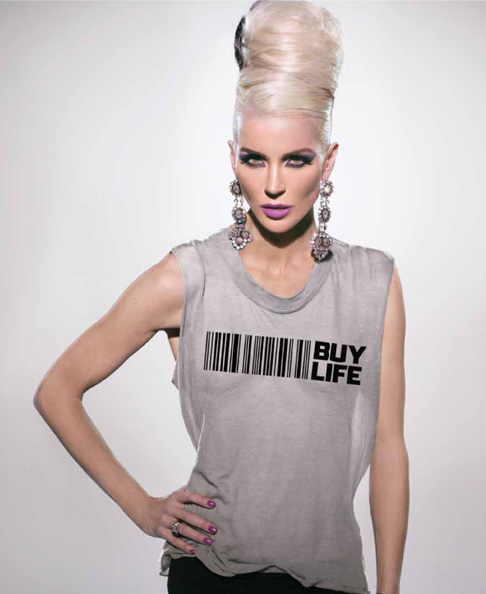 Daphne Guinness
buy life campaign
Continuing in this moment of seeming non-sequiter I have to make a confession. Without any advanced warning that this would happen, my 30 days of iconic photos of inspirational women happened to overlap with a profound personal event. It turns out near the beginning of the month I met someone I liked an awful lot and over the course of the month I actually fell in love. There's a saying that comes from somewhere all insightful and wise that says Love is a spontaneous grass, not a garden plant. That is, it comes up in fresh ground, almost unexpected, without being intentionally cultivated, and truth be told, without your input or control. The thing is, I've resisted those kinds of views about love. I have long thought of it as a more determined thing, and even if I was willing to grant that perhaps the feelings could not be directly controlled part of me tried to maintain that I could somehow sculpt the channel through which they'd flow, there by shaping how the feelings would go. There's a sense in which this has "worked" for me, in as much as controlling our feelings can ever work for anyone--it's a little like pouring freshly shaken soda pop down a fountain--even if the liquid more or less follows the predetermined path it's gonna bubble and blow all over other stuff too.
Somehow before this last month my own attempts to control such things had waned. I can't exactly say how I managed this except that I know I have spent the last year very intentionally simplifying my own life and I believe that through this process I opened my self up to greater intimacy with my own feelings--living in a kind of communion with them, rather than needing to try and direct them as objects separate from me.
Let me say I tried, when I met this person I liked a lot, not to fall in love. First I called and told him we couldn't see each other. He responded so well to that though I realized I wanted to see him and relented. So we visited together and I liked it a lot and then I freaked out again and said again we couldn't see each other. Then I was walking through town and somehow ended up in the same general area that he was so I tried to cross the street before bumping into him and without realizing it put myself right on the edge of a SIDEWALK CLOSED CROSS BACK TO OTHER SIDE OF THE STREET situation. Really. The avoidance route wasn't open to me anymore. So I crossed back over to the original side of the street, and then a few minutes later there he was beside me calm and smiling. After that we started spending more regular time together. (Honestly, I actually freaked out again more and everytime there he'd be beside me calm and smiling. The truth is I've never had anyone capable of doing that with me. In the past I've had to be the one that stays calm and smiling while someone else freaks out, and if it was my turn to freak out there wasn't really someone there to stay calm next to me. I'd end up in a room on my own talking myself through it.)
Anyway, the point of all this is it's been a struggle for me. In the midst of falling in love I've faught myself outside my own heart quite a lot, while inside my own heart I've softened and come to understand myself in an entirely new way. It isn't that I've gone without feelings for others in the past. It's that this time I've gotten to be more fully myself in the midst of them, and be more fully recognized by him than anyone has before. Still, it's been hard.
What the hell does any of this have to do with Daphne Guinness?
Here's part of the tension I'm dealing with--my heart is open and in a sense has already given itself to someone. In that level of simple connection I feel as though we are two hands calm and holding each other. In that I feel a kind of constancy I want, a constancy that inspires me to think better of myself, to see life as more fully full of possibility, to recognize that I can passionately choose the life I want. At the same time, the future of this situation is fully indeterminate. It is of course indeterminate in that existentialist sense of life is wide open and we can't predict where it will take us. But, the future of this particular circumstance is also indeterminate in the literal sense--we've only recently met and started spending time together and our everyday life plans right now appear to take us in significantly different directions. (I choose here not to get into details out of respect for both our privacy, but let me just say it's all more about geography than any more green and gobbly relationship eating monsters in case you're out there projecting all kinds of panic and worry into all this for my sake.)
It would be easy in such a situation to decide in advance that things can't work and to close down to all the feeling I've had. Or, it could be easy (for a time) to naively give myself away to just the feeling and dwell in the fantasy of what I imagine is possible hoping everyday life will eventually match up. The bigger challenge, and the one I'm recognizing is essential for me to live out here, is the risky maneuever of honestly facing both truths of this relationship--my heart is open and has given itself to someone, and what that will mean in literal terms of the relationship it will continue to develop is entirely unclear. I cannot predetermine what the meaning of all this will be, nor can I decide before its time what form of relationship all this will get to take. Instead, I can only know that I've gotten to know my own heart more fully than ever before, even when the truth is it's only been a month. As fluffy as that sounds, as my friend Matt pointed out when I talked to him about all of this -- we really love a marshmallow. That is, we're both people that look really damned good in black leather, and black leather-like variants, like black polyeurethane, or black vinyl, or black latex, or other forms of black pleather, and black leather-like variants, and there is something fantastically tough about that and we really do both own clothing made out of all those things. But truth be told, we also really love a marshmallow--a soft and sometimes fluffy heart. There is no paradox in that. Or, at least, if there is a paradox, there is something important about living the the truth of BOTH irreconcilable positions honestly, and in recognizing that the apparent contradiction might be definitively who or what we as humans are.
 Daphne Guinness
circa Spring 2008
This brings me, finally, back to the 30-day iconic photo challenge. I could easily just write up a bio with appropriately iconic accompanying photo of Daphne Guinness, back date it to appear on this blog on what would have been the 30th day of that challenge and leave it at that. Somehow, instead I'm writing up all of this.
When the idea of writing about Daphne Guinness here (and I've posted about her on this blog plenty before) occurred to me I resisted initially because I didn't want to have to explain why she should count as one of the 30 day women, nor why she was appropriately THE 30th woman that would frame our reading of all the rest, even though in many ways I shouldn't have to explain anything. How she counts seems to me just obvious.
Daphne Guinness is regularly touted as a fashion icon. She has an incredible ability to transform herself aesthetically and to direct her form through a wide range of appearances. But, to use the word "appearances" there is misleadingly simplistic. In her wielding of what we could call "style" or "fashion" -- her ability to just get dressed -- Daphne Guinness reveals how thoroughly our interactions with each other, or our responses to others, are dictated and trained by appearances. Her ability to transmogrify her very persona through what we often take as the simple notion of self presentation calls attention to how very used to our own social standards and norms of human appearance we really are. She has an incredible ability to pull on our standards of beauty, repulsion, glamor, discomfort, female form, and human body all at the same time. In so doing she often pushes us out of our own preferences for these norms (I'll admit I haven't posted some of the more vivid examples of her enacting this sense of "pushing us out of our own preferences" -- such images can readily be found online simply by searching her name). In this way, Guinness allows us to see how the reality of something as simple as getting dressed is actually a complex intersection of our profound ability to on the one hand choose exactly what we want to be, while on the other hand being fully incapable of escaping the pressures of how others are going to perceive us and therefore respond to and interact with us. That is, Daphne Guinness illustrates that the utterly simplistic act of putting on clothes in the morning is a lived paradox too--our accoutrement and presentation arises out of two irreconcilable truths--we can choose who and what we want to be, and we are constrained by our interactions with others. But even more importantly, Daphne Guinness shows us how fantastical, extravagant, and fulfilling it can be to take up the irreconcilable truths of this process and so live them both out honestly simultaneously. That is, Daphne Guinness is the woman fully alive, fully expressed through paradox.
 Daphne Guinness
image from Harper's Bazaar
February 2011
When the idea of writing about Daphne Guinness here (and I've posted about her on this blog plenty before) occurred to me I resisted initially because I didn't want to have to explain why she should count as one of the 30 day women, nor why she was appropriately THE 30th woman that would frame our reading of all the rest, even though in many ways I shouldn't have to explain anything. How she counts seems to me just obvious.
Daphne Guinness is regularly touted as a fashion icon. She has an incredible ability to transform herself aesthetically and to direct her form through a wide range of appearances. But, to use the word "appearances" there is misleadingly simplistic. In her wielding of what we could call "style" or "fashion" -- her ability to just get dressed -- Daphne Guinness reveals how thoroughly our interactions with each other, or our responses to others, are dictated and trained by appearances. Her ability to transmogrify her very persona through what we often take as the simple notion of self presentation calls attention to how very used to our own social standards and norms of human appearance we really are. She has an incredible ability to pull on our standards of beauty, repulsion, glamor, discomfort, female form, and human body all at the same time. In so doing she often pushes us out of our own preferences for these norms (I'll admit I haven't posted some of the more vivid examples of her enacting this sense of "pushing us out of our own preferences" -- such images can readily be found online simply by searching her name). In this way, Guinness allows us to see how the reality of something as simple as getting dressed is actually a complex intersection of our profound ability to on the one hand choose exactly what we want to be, while on the other hand being fully incapable of escaping the pressures of how others are going to perceive us and therefore respond to and interact with us. That is, Daphne Guinness illustrates that the utterly simplistic act of putting on clothes in the morning is a lived paradox too--our accoutrement and presentation arises out of two irreconcilable truths--we can choose who and what we want to be, and we are constrained by our interactions with others. But even more importantly, Daphne Guinness shows us how fantastical, extravagant, and fulfilling it can be to take up the irreconcilable truths of this process and so live them both out honestly simultaneously. That is, Daphne Guinness is the woman fully alive, fully expressed through paradox.
 Daphne Guinness
image from Harper's Bazaar
February 2011
It is often said in our culture that fashion, or worry about outward appearance as presented through the idea of clothing, is superficial. By extension, people that focus on such things, or take such things to be important are also claimed to be shallow. I read years ago in an article on fashion published in THE NEW YORK TIMES that this commonly held view is arguably just a hold over from our Enlightenment era view that the mind and body are separate or separable, and the mind is more important than the body. In such a view the body would just be a vehicle for our more powerful thoughts. In fact, the venerable Roger Ebert (whose blog I very much like to read) made exactly this claim just this last week.
What I'm claiming here is that Daphne Guinness shows how wrong such a view turns out to be. Of course there is some sense in which a person could live a shallow life focused too much on fashion. But that's not what we're talking about here. The commonly held view mentioned above assumes that the body itself is somehow less important than the mind, and by extension fashion simply is shallow because it doesn't dwell in the land of thoughts. I'm saying that Daphne Guinness is not only inspirational, but also iconic because she makes vivid how the body is precisely the land of thoughts, or, more accurately, the two are simply not separate--aesthetics is the dance through which the two marry and dwell.
What I'm claiming here is that Daphne Guinness shows how wrong such a view turns out to be. Of course there is some sense in which a person could live a shallow life focused too much on fashion. But that's not what we're talking about here. The commonly held view mentioned above assumes that the body itself is somehow less important than the mind, and by extension fashion simply is shallow because it doesn't dwell in the land of thoughts. I'm saying that Daphne Guinness is not only inspirational, but also iconic because she makes vivid how the body is precisely the land of thoughts, or, more accurately, the two are simply not separate--aesthetics is the dance through which the two marry and dwell.
What the hell, then, does Daphne Guinness have to do with love?
 Daphne Guinness
2010 Nars Makeup Ad Campaign
 Daphne Guinness
2010 Nars Makeup Ad Campaign
The thing about my romantic situation is that there is no honest way for me to determine its future right now. If I was to try and demand it to be more than it is, I would have to be pushing it into a form of relationship that is not arising from the genuine interactions of he and I together, but instead is being grabbed from the grab-bag of social norms for romantic relationships--marriage, engagement, affair, friendship-only, etc. Any of these, are of course, wonderful forms for romantic relationships to take when they arise from the energy and commitment of the two people in the relationship. But, very often we instead grasp for security by trying to squeeze what we feel with someone into one of these shapes before the relationship has gotten to such a state all on its own. I could, of course, also just end it and walk away from the relationship as it stands telling myself things like it is too amorphous for me to feel right in it, or that it doesn't have enough to offer me to feel secure, or etc. The truth is, it is, perhaps a little amorphous right now, and it might not be offering me total security right now either, but it might also be too soon to know if the relationship will develop its own clearer shape, or what level of security it could have to offer. The point, I'm making is that right now it is still time, it seems, for me to dwell in the wealth of feeling I have found and to remain open to an indeterminate future too. What I'm pointing out is that much like how we are quick to assume a focus on fashion is superficial, we as people also seem quick to assume that having important romantic feeling for someone means we must move into a romantic relationship with a determined, or committed-to future, and short of that we're doing something wrong, or we're just having one-night stands. Importantly, this isn't to say that we should avoid those relationships where we want to and do commit to pre-determined futures. There are times when marriage, for example, is a wonderful thing to do. This also isn't to say that people that engage in either serial monogamy or so-called one-night stands are doing the better thing by refusing to commit--notice in either of these cases we might say there is a sense in which such people have precisely committed--that is to not having a continuing future with the person (or people) they engage in those activities with.
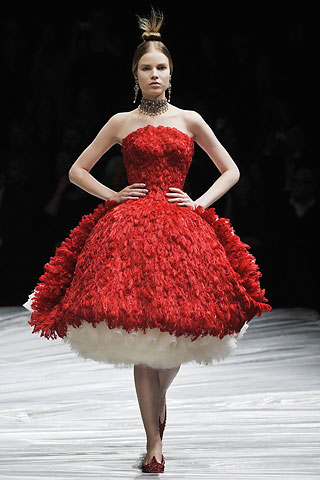
 Daphne Guinness (in red dress)
Vogue Italia
 Daphne Guinness (in red dress)
Vogue Italia
Camus describes the human condition as a lived paradox. For him the way to live a genuine, or what I've been calling an honest life, is to accept that we live in conditions that simply are a paradox--that at a foundational level what it is to be human is to have to face two irreconcilable conditions of human existence and refuse to deny either one of them or attempt to reconcile them either. We must dwell in what seems like an impossible state of accepting an apparent contradiction. For Camus, this contradiction is found in relation to the simple reality that we do die. He states that to be fully alive in our human condition we must face the very real reality of our death and refuse to live it now. That is, we must accept that we will die and as a result here on earth we will also eventually be forgotten, but perhaps more importantly, each and every one of the projects we take up now while we are living will come to an end. Our investment in them will be as naught, even if someone else takes them up for us after we die--our own investment in them will be over. We will be gone. In a certain sense that makes everything we are invested in now meaningless--when we measure our lives against an infinite horizon it is as if we cannot even be seen to exist. Still, the truth is, here we are very much alive, panting and heart-beating our way through every moment of our lives right up until that very second in which both our breath and our heart stops. These moments of breath and heart belong to us and to us alone. That is NOT to say our lives are isolated to us alone and that our choices impact no one. That IS to say our lives are ours to choose what to do with and those projects we choose to invest in (including the people we have relationships with) are precisely what make our lives utterly meaningful. That is, we decide. We make our lives meaningful. It is not some pre-determined future we are working our way towards--it is us right now in our choosing. Camus describes this state as living in acceptance of our mortality without being resolved to it--that is, we face everyday the knowledge that we will die, without resolving ourselves to the limitations it might seem to imply. We accept that we will die precisely to demand we be alive now.
We make our lives meaningful. This is true whether we are my dear friend Kim that I featured part way through my 30-day iconic photo challenge--a woman who lives every day in faith, fully committed to raising two beautiful kids with a rambunctious adorable dog and a loving husband--or whether we are Marilyn Monroe, a woman whose persona was shaped in, in response to, and in a sense for the public spotlight, but whose life, nonetheless, was chosen and successfully expressed as a pinnacle of that Hollywood glamor. In both cases we find women that everyday wake up and re-choose their lives, determining in this sense for themselves the meaning it will have--both, strongly in relation to the effects of their own lives on other people, but the choice arises nonetheless precisely from themselves.
Similarly, Daphne Guinness everyday chooses a life that expresses another aspect of the human paradox--that we can reshape how we are taken by others, how we appear to ourselves, and thus too how we are expressing the way we feel about being in the world, that our insides and our outsides are continuously co-creating and in interaction with each other.
 Daphne Guinness
Vogue Italia 2010
Right now I rest in my own sort of paradox. I am here carefully trying to navigate the reality between my open heart and how it leads me to imagine a possible future with a man while at exactly the same time the practical realities of the situation would seem to point in the direction of a different possible future. I know many people would tell me the practical realities tell me to stop being involved. While I know too many other people that would tell me the feelings mean to change everything for the sake of continuing in those feelings.
I am saying that Camus is right--to live this situation genuinely I need to accept that both things here right now are true without resolving to pre-determine the conclusion for this situation based on either one. That is, I can't claim this situation means there is no possible future just because our everyday lives bring us in different directions. But I also cannot claim there is the brightest possible future just because my heart can't help but love him. To claim either would be to deny the truth of the rest of the situation.
What I do know is that in the midst of this I have gotten to live in and recognize my own heart more fully than I ever have before, even as I also recognize I do not know where all this will bring me even just next week. This will be true even if the daily aspects of this relationship end tomorrow.
 Honourable Daphne Suzannah Diana Joan Guinness
image by Rene Habermacher
I don't approach fashion. Fashion approaches me.
-Daphne Guinness
He is quite obviously the love of my life.
-Daphne Guinness, on her relationship with French philosopher Bernhard-Henri Levy
The heiress to the Guinness Beer fortune, Daphne Guinness married the son of a Greek shipping billionaire in her early 20's. Together they had three children. It is understood that though in merely financial terms Guinness had access to practically anything in the world, the marriage quickly became quite unhappy for her, resulting in her living a rather limited personal life. To cope with the unhappy situation Guinness dove into the world of fashion accumulating what was already at the time a greatly admired collection of haute couture, and other unique pieces from the fashion world. She became known not only for her impressive access to fashion designs, but also for her own impeccable talent for showing such pieces at their best on her. As a result, she was named to the International Best Dressed List in 1994.
Guinness divorced in 1999. Though she initially took time to live in comparable solitude, her unique style eventually connected her to work as a fashion journalist and stylist for some of the most interesting and prominant fashion magazines in the world. Several years after her divorce Guinness donated the entirety of her fashion collection from the period of her marriage to auction with all proceeds being given to charity. When asked about the choice she said that though she had loved the pieces dearly, they were also associated with incredible grief in her life so that she was ready to start fresh and allow her previous grief to be transformed into a financial difference for others.
Several years ago Guinness befriended the French philosopher Bernard-Henry Levi. She has described their relationship as including a strong connection that she resisted initially, both for being wary because of her romantic past and because Levi is married. She has never had an inclination to date married men, even if there have been numerous opportunities. Over the years the two continued to bump into each other at various social events, and also then to simply choose to develop their connection further. Guinness admits a kind of contradiction to her relationship with Levy. Of it she says the following.
He is quite obviously the love of my life. My greatest sorrow has been the unresolved question of the state of our relationship. ...when things are real, and when there is bound to be collateral damage, you have to look at what's most precious. And that's love.
We make our lives meaningful. This is true whether we are my dear friend Kim that I featured part way through my 30-day iconic photo challenge--a woman who lives every day in faith, fully committed to raising two beautiful kids with a rambunctious adorable dog and a loving husband--or whether we are Marilyn Monroe, a woman whose persona was shaped in, in response to, and in a sense for the public spotlight, but whose life, nonetheless, was chosen and successfully expressed as a pinnacle of that Hollywood glamor. In both cases we find women that everyday wake up and re-choose their lives, determining in this sense for themselves the meaning it will have--both, strongly in relation to the effects of their own lives on other people, but the choice arises nonetheless precisely from themselves.
Similarly, Daphne Guinness everyday chooses a life that expresses another aspect of the human paradox--that we can reshape how we are taken by others, how we appear to ourselves, and thus too how we are expressing the way we feel about being in the world, that our insides and our outsides are continuously co-creating and in interaction with each other.
 Daphne Guinness
Vogue Italia 2010
Right now I rest in my own sort of paradox. I am here carefully trying to navigate the reality between my open heart and how it leads me to imagine a possible future with a man while at exactly the same time the practical realities of the situation would seem to point in the direction of a different possible future. I know many people would tell me the practical realities tell me to stop being involved. While I know too many other people that would tell me the feelings mean to change everything for the sake of continuing in those feelings.
I am saying that Camus is right--to live this situation genuinely I need to accept that both things here right now are true without resolving to pre-determine the conclusion for this situation based on either one. That is, I can't claim this situation means there is no possible future just because our everyday lives bring us in different directions. But I also cannot claim there is the brightest possible future just because my heart can't help but love him. To claim either would be to deny the truth of the rest of the situation.
What I do know is that in the midst of this I have gotten to live in and recognize my own heart more fully than I ever have before, even as I also recognize I do not know where all this will bring me even just next week. This will be true even if the daily aspects of this relationship end tomorrow.
 Honourable Daphne Suzannah Diana Joan Guinness
image by Rene Habermacher
I don't approach fashion. Fashion approaches me.
-Daphne Guinness
He is quite obviously the love of my life.
-Daphne Guinness, on her relationship with French philosopher Bernhard-Henri Levy
The heiress to the Guinness Beer fortune, Daphne Guinness married the son of a Greek shipping billionaire in her early 20's. Together they had three children. It is understood that though in merely financial terms Guinness had access to practically anything in the world, the marriage quickly became quite unhappy for her, resulting in her living a rather limited personal life. To cope with the unhappy situation Guinness dove into the world of fashion accumulating what was already at the time a greatly admired collection of haute couture, and other unique pieces from the fashion world. She became known not only for her impressive access to fashion designs, but also for her own impeccable talent for showing such pieces at their best on her. As a result, she was named to the International Best Dressed List in 1994.
Guinness divorced in 1999. Though she initially took time to live in comparable solitude, her unique style eventually connected her to work as a fashion journalist and stylist for some of the most interesting and prominant fashion magazines in the world. Several years after her divorce Guinness donated the entirety of her fashion collection from the period of her marriage to auction with all proceeds being given to charity. When asked about the choice she said that though she had loved the pieces dearly, they were also associated with incredible grief in her life so that she was ready to start fresh and allow her previous grief to be transformed into a financial difference for others.
Several years ago Guinness befriended the French philosopher Bernard-Henry Levi. She has described their relationship as including a strong connection that she resisted initially, both for being wary because of her romantic past and because Levi is married. She has never had an inclination to date married men, even if there have been numerous opportunities. Over the years the two continued to bump into each other at various social events, and also then to simply choose to develop their connection further. Guinness admits a kind of contradiction to her relationship with Levy. Of it she says the following.
He is quite obviously the love of my life. My greatest sorrow has been the unresolved question of the state of our relationship. ...when things are real, and when there is bound to be collateral damage, you have to look at what's most precious. And that's love.